
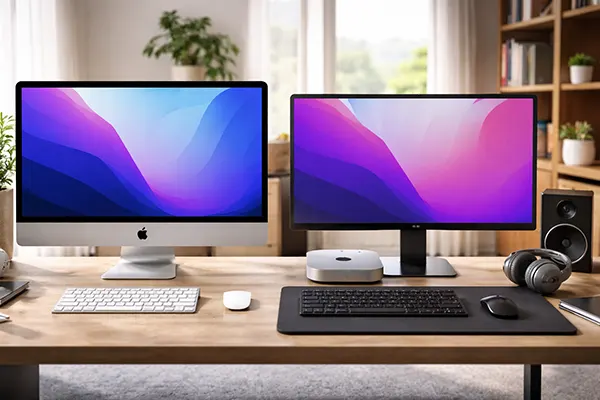
iMac vs Mac mini: Which Is Better for a Home Office in 2025?
Choosing a Mac for a home office in 2025 is no longer just about performance. Cost of ownership, upgrade flexibility, desk space, and long-term usability all matter more than ever. Apple’s current iMac and Mac mini models are built on the same Apple Silicon architecture, yet they serve very different needs. This comparison focuses on real-world home office use rather than specifications alone.
Total Cost of Ownership in a Home Office Setup
At first glance, the iMac appears more expensive than the Mac mini, but the initial price does not tell the full story. The iMac includes a high-resolution display, speakers, webcam, and keyboard and mouse, which significantly reduces the need for additional purchases. For many home users, this bundled approach simplifies budgeting and setup.
The Mac mini, while cheaper at entry level, requires a monitor, input devices, and often external speakers or a webcam. A quality 4.5K or 5K display comparable to the iMac’s panel can noticeably increase the total spend. Over several years, these accessories also influence maintenance and replacement costs.
Energy efficiency is another factor. Both devices are extremely power-efficient thanks to Apple Silicon, but the Mac mini paired with large external displays may consume slightly more energy overall. For users working daily from home, these small differences add up over time.
Hidden Costs and Long-Term Expenses
Storage and memory upgrades remain costly across Apple’s lineup. With the iMac, internal upgrades must be chosen at purchase, as post-purchase upgrades are not possible. This requires careful planning but ensures a clean, integrated system.
The Mac mini offers more flexibility through external SSDs and hubs. While internal memory is still fixed, external storage solutions are more practical for long-term expansion. This approach can reduce costs when working with large files or backups.
Repair and replacement considerations also matter. If an iMac display fails, the entire unit is affected. With a Mac mini, peripherals are independent, which can reduce repair costs and downtime.
Upgrade Flexibility and Future-Proofing
In 2025, Apple continues to refine its Apple Silicon chips, and both iMac and Mac mini benefit from these improvements. Performance differences between similarly configured models are minimal for typical home office tasks such as document work, web applications, photo editing, and light video editing.
The iMac is designed as a closed system. What you buy is what you will use for its entire lifespan. This suits users who prefer stability and do not plan to modify their setup frequently.
The Mac mini is more modular by nature. Users can change displays, add new accessories, and adapt the workspace as needs evolve. This flexibility is valuable for freelancers or professionals whose requirements change over time.
Longevity and Software Support
Apple provides long-term macOS updates, typically supporting devices for many years. Both iMac and Mac mini purchased in 2025 can be expected to receive updates well into the 2030s, making them safe long-term investments.
Thermal performance also influences longevity. The Mac mini’s compact design includes efficient cooling, especially in higher-end configurations. Sustained workloads such as video exports can be handled reliably.
The iMac’s larger chassis allows for quiet operation even under load, which is important in a home office environment where noise can be distracting during calls or focused work.
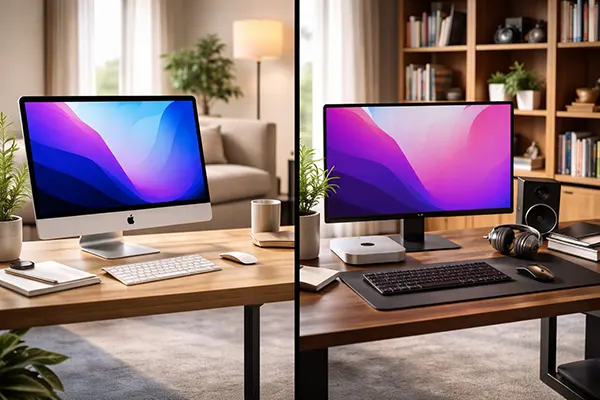
Who Should Choose iMac and Who Is Better Served by Mac mini
The iMac is well suited for users who want a clean, minimal desk and a straightforward setup. It works particularly well for writers, consultants, designers, and remote employees who value visual quality and simplicity.
Mac mini is a better choice for users who already own a high-quality monitor or plan to use multiple displays. Developers, analysts, and technically inclined users often prefer this flexibility.
Budget planning also plays a role. While the Mac mini can be cheaper initially, the iMac often becomes more cost-effective when factoring in equivalent accessories.
Practical Home Office Scenarios
For a shared household workspace, the iMac’s all-in-one design reduces clutter and simplifies daily use. It can easily switch between work and personal tasks without reconfiguration.
For dedicated workspaces with specific ergonomic needs, the Mac mini allows precise control over monitor height, size, and orientation. This is important for long working hours.
Both devices handle video calls, cloud-based tools, and productivity software effortlessly in 2025. The decision ultimately depends on how much control the user wants over their environment.
Related articles
-
 iPhone 17e vs Used iPhone 16 Pro: Whi...
Choosing between a brand-new mid-range iPhone and a previously owned …
-
 MacBook for Study and Office in 2026:...
Choosing a MacBook for study or office work in 2026 …
-
 Mac for Media Work in 2026: How to Ch...
Choosing a Mac for professional media work in 2026 is …