
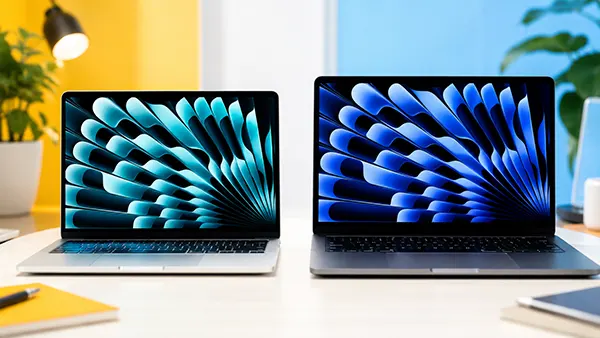
M5 MacBook Air vs M5 MacBook Pro: What to Choose for Study, Work, Coding, Photo and Video Editing
Apple’s M5 generation has changed the way many people approach portable computers in 2026. The latest MacBook Air and MacBook Pro models now share stronger efficiency, longer battery life and faster AI-driven processing than previous generations, yet they still target different types of users. Students, developers, designers, editors and remote workers often compare these two machines because the pricing gap is no longer the only factor worth considering. Screen technology, thermal design, memory bandwidth, graphics performance and connectivity all play an important role when choosing a laptop that will remain relevant for several years.
Design, Portability and Everyday Comfort
The M5 MacBook Air remains the lightest and most travel-friendly notebook in Apple’s current line-up. In 2026, the 13-inch and 15-inch Air models continue to attract students and professionals who carry a laptop daily between lectures, offices, cafés or co-working spaces. The thin chassis makes it comfortable for commuting, while the fanless construction keeps the device completely silent during writing, browsing, presentations and online meetings. For people who spend most of their day inside Safari, Microsoft Office, Notion, Slack or Google Workspace, the Air already feels extremely fast.
The M5 MacBook Pro, meanwhile, is noticeably heavier but delivers a more advanced hardware configuration. Apple still equips the Pro line with active cooling, brighter displays and additional ports, which makes it more suitable for demanding professional environments. Editors working with external SSDs, photographers transferring large RAW libraries and developers connecting multiple accessories benefit from HDMI, additional Thunderbolt ports and improved sustained performance under long workloads.
Battery life is excellent on both devices in 2026, but usage patterns matter. The MacBook Air can comfortably last through a full university day with note-taking, streaming and browser multitasking. The MacBook Pro performs better during intensive workflows such as 4K video exports, Xcode compilation or AI-assisted rendering because the cooling system prevents thermal throttling during extended sessions. As a result, the Pro maintains stable speeds longer when the workload becomes heavy.
Display Quality, Keyboard and Daily User Experience
Apple’s Liquid Retina displays on the M5 MacBook Air are sharper and more colour-accurate than many Windows ultrabooks in the same category. Text rendering looks clean, which benefits students reading PDFs or developers writing code for hours. Brightness levels are sufficient for indoor and moderate outdoor work, while the improved anti-reflective coating introduced in recent models helps reduce glare under strong lighting conditions.
The M5 MacBook Pro still offers the superior visual experience. Its mini-LED display with higher peak brightness and ProMotion refresh rates is especially valuable for photographers, colour graders and video editors. Motion appears smoother during scrolling and timeline editing, while HDR footage looks significantly more detailed. Professionals working in Final Cut Pro, DaVinci Resolve or Adobe Lightroom can see the difference immediately when comparing both displays side by side.
Typing comfort is nearly identical because Apple uses a similar Magic Keyboard design across both lines. The large trackpad remains one of the strongest reasons many users stay within the macOS ecosystem. Gestures, precision and palm rejection continue to outperform most competing laptops in 2026. Even users switching from desktop systems adapt quickly thanks to the responsive touch surface and consistent macOS navigation.
Performance for Coding, Multitasking and Professional Work
The M5 chip inside the MacBook Air is already powerful enough for most coding tasks. Developers working with Python, JavaScript, VS Code, Docker containers or lightweight iOS projects will rarely feel limited during standard workloads. Apple Silicon optimisation across modern developer tools has improved significantly by 2026, meaning even the base Air configuration can handle large browser sessions, terminal environments and cloud-based workflows smoothly.
However, the M5 MacBook Pro becomes a much stronger option when projects scale upward. Developers building large applications in Xcode, running virtual machines or training AI models locally benefit from the enhanced GPU cores, active cooling and higher memory ceiling. The Pro also performs better under sustained compiling sessions because temperatures stay lower during prolonged CPU-intensive tasks.
For office work and multitasking, both laptops feel extremely responsive, but RAM configuration matters more than many buyers expect. In 2026, 16GB of unified memory should be considered the practical minimum for long-term usage, especially for users who keep dozens of browser tabs open or work with creative applications simultaneously. Buyers choosing between Air and Pro should prioritise memory upgrades before spending excessively on storage.
Photo Editing, Video Production and AI Workflows
Photo editing on the M5 MacBook Air is surprisingly capable. Applications such as Adobe Photoshop, Affinity Photo and Lightroom run smoothly with modern Apple Silicon optimisation. Casual photographers, bloggers and social media creators can edit high-resolution images without major slowdowns. The Air is especially attractive for travelling creators who value low weight and long battery life more than maximum export speeds.
The MacBook Pro gains a clear advantage once video production enters the discussion. Editing multi-layer 4K footage, handling ProRes workflows or rendering long-form content in Final Cut Pro stresses the Air much faster because of its passive cooling system. The Pro sustains high performance for significantly longer periods and supports more demanding codecs and effects processing without aggressive thermal limitations.
Artificial intelligence workflows have also become more relevant in 2026. Many creators now rely on local AI tools for transcription, image enhancement, coding assistance and media generation. The M5 Pro and higher-tier configurations process these tasks faster thanks to improved GPU throughput and neural processing capabilities. Users interested in future-proofing their workflow for AI-assisted creative software often find the Pro to be the safer long-term investment.

Which MacBook Makes More Sense in 2026
The M5 MacBook Air is the stronger value option for students, writers, office professionals and users who mainly need portability combined with dependable performance. It handles web-based workloads, document editing, media streaming and moderate creative tasks extremely well while remaining quieter and easier to carry than the Pro. For many people, the Air already delivers more performance than they realistically use every day.
The M5 MacBook Pro is aimed at users whose work directly depends on sustained performance and advanced hardware capabilities. Software engineers, filmmakers, photographers and music producers benefit from the improved cooling system, display quality, speaker system and broader connectivity. Although it costs more, the extra performance headroom becomes important for professionals planning to keep the machine for four to six years.
Price-to-performance balance should remain the central factor during the purchase decision. In many situations, upgrading a MacBook Air with additional RAM and storage creates a more balanced configuration than buying an entry-level MacBook Pro. At the same time, users working with demanding software every day may regret choosing the Air if export times, rendering workloads or thermal limitations start affecting productivity after several years of use.
Best Choice for Different Types of Users
Students and general users will usually be happier with the M5 MacBook Air because it combines long battery life, low weight and enough processing power for modern academic and professional software. It is especially practical for university work, note-taking, browsing, research, online collaboration and entertainment. The Air also remains the quieter option because it has no internal fan.
Developers and technical professionals should evaluate the size and complexity of their workflows before choosing. Front-end developers, remote workers and cloud-based engineers can comfortably work on the Air, while back-end developers handling large local environments, Android emulators or machine learning tools are more likely to benefit from the Pro. External monitor support and memory upgrades also become more important in these cases.
Creative professionals working with photography, cinema cameras, 3D rendering or advanced video production are still better served by the M5 MacBook Pro in 2026. The brighter display, stronger GPU performance, active cooling and faster sustained rendering speeds create a more stable environment for demanding professional work. While the Air continues to narrow the gap each year, the Pro remains Apple’s more complete machine for high-performance creative production.
Related articles
-
 Mac mini with M6 in 2026: What Change...
The 2026 Mac mini is a more substantial update than …
-
 MagSafe and Qi2 25W in 2026: Which Wi...
Wireless charging is more straightforward on the iPhone 17 generation …
-
 App Store 18+ Ratings and Declared Ag...
Apple’s age-safety rules are more detailed in 2026, but two …