
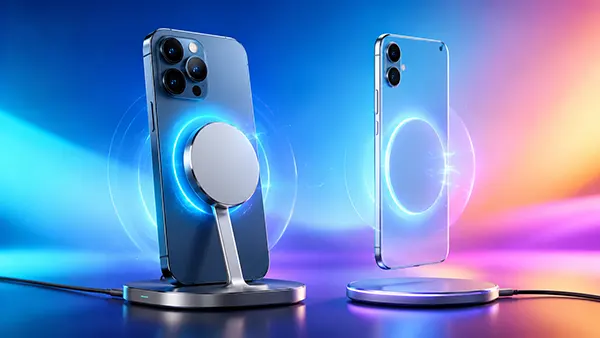
MagSafe and Qi2 25W in 2026: Which Wireless Charger Do You Need for iPhone 17 and iPhone Air?
Wireless charging is more straightforward on the iPhone 17 generation than it was a few years ago, but choosing the right charger still requires attention to one important detail: iPhone 17 and iPhone Air do not have the same wireless charging limit. The standard iPhone 17 supports both MagSafe and Qi2 wireless charging at up to 25W, while iPhone Air supports both systems at up to 20W. This means that a modern Qi2 25W charger can be a suitable purchase for either phone, but the Air will not draw the full 25W simply because the charger can provide it. Charger certification, the USB-C power adapter, case design, temperature and the way the phone is being used can also affect real charging speed. Understanding these differences makes it much easier to decide whether a new 25W charger is worthwhile or an existing MagSafe or Qi2 accessory is already sufficient.
How MagSafe and Qi2 25W Charging Work in 2026
Qi2 25W is the newer high-power version of the Qi2 wireless charging standard. The Wireless Power Consortium introduced the specification as Qi v2.2.1 in July 2025, building on the original Qi2 system that provided magnetic alignment and charging at up to 15W. The move to 25W increased the maximum available charging power substantially while keeping the magnetic positioning that is central to Qi2. Correct alignment matters because wireless charging works best when the charging coils in the phone and charger remain centred over one another. Magnets make that alignment consistent, so the phone is less likely to sit slightly off-centre on the charging surface and lose efficiency.
Apple’s current MagSafe Charger fits into this newer charging environment rather than operating as an entirely separate solution. The present model is certified for Qi2 25W as well as Qi charging and can provide wireless charging at up to 25W when it is connected to a suitable 30W power adapter. Apple sells it with an integrated USB-C cable in 1-metre and 2-metre versions, but the wall adapter is a separate item. For an iPhone owner, the practical difference between Apple’s charger and a properly certified third-party Qi2 25W model is therefore less about the headline wattage and more about design, cable length, stand or pad format, build quality and the other devices that the accessory is intended to charge.
The phone itself ultimately determines how much of that available power can be used. Apple specifies iPhone 17 for MagSafe charging at up to 25W and Qi2 charging at up to 25W. The iPhone Air specification sets both MagSafe and Qi2 at up to 20W. A 25W charger does not override that 20W limit. This distinction is particularly useful when comparing products in shops, because the number printed on a charger describes the charger’s supported output rather than guaranteeing that every connected phone will accept that amount. A Qi2 25W charger can therefore be an appropriate accessory for iPhone Air, but it should be bought for compatibility, convenience or future use rather than on the assumption that it will turn Air into a 25W wireless-charging phone.
What Charging Speed Should You Actually Expect?
For iPhone 17, Apple’s own testing gives a useful reference point. With a MagSafe Charger and a 30W or more powerful adapter, the phone can reach around 50% charge in approximately 30 minutes under Apple’s test conditions. Wired charging remains faster when a short emergency top-up is the main priority: Apple rates iPhone 17 for around 50% in 20 minutes when it is connected by USB-C to a 40W or more powerful adapter. That ten-minute difference does not make wireless charging slow, but it shows why MagSafe and Qi2 are better viewed as a combination of useful speed and convenience rather than replacements for the fastest possible cable connection.
Apple also rates iPhone Air for approximately 50% charge in 30 minutes with a MagSafe Charger connected to a 30W or more powerful power adapter. This figure sometimes causes confusion because the current Apple MagSafe Charger itself is a 25W accessory, while the Air technical specification states a maximum of 20W for both MagSafe and Qi2. The model-specific specification is the important figure when judging the maximum wireless input of the phone. Charging time cannot be calculated simply by dividing battery capacity by charger wattage either. Power changes during a charging session, especially as the battery fills, so a phone that reaches 50% in about half an hour will not necessarily reach 100% after another identical 30-minute period.
Real use introduces further variation. Wireless charging produces heat, and iOS can reduce or temporarily pause charging if the battery becomes too warm or too cold. Charging can also be slower while the phone is running demanding applications, recording video, playing a graphics-heavy game or streaming high-quality video at high display brightness. Apple additionally states that attaching a USB-C or Lightning accessory while the iPhone is charging wirelessly can limit wireless charging to 7.5W. In iOS 26, users can check the Battery section for an estimated time to 80%, 100% or the selected charge limit, making it easier to judge actual performance instead of relying only on the wattage written on the charger box.
Which Wireless Charger Should You Buy for iPhone 17 or iPhone Air?
For a new iPhone 17, a 25W-capable charger is the logical choice when fast wireless charging matters. The simplest Apple-branded option is the current MagSafe Charger paired with a 30W or more powerful USB-C adapter. A certified Qi2 25W charger from another manufacturer can also make sense, particularly when a stand, longer cable, different desk layout or multi-device design is more useful than Apple’s circular charging puck. The key wording to look for is Qi2 25W certification rather than a general statement that an accessory is magnetic or works with MagSafe cases. Magnetic attachment alone says nothing about whether the charger has been certified to deliver the newer 25W Qi2 charging mode.
For iPhone Air, the buying decision is slightly different because the phone’s wireless charging ceiling is 20W. If you are buying a charger from scratch in 2026, a Qi2 25W model can still be a sensible long-term choice. It gives the Air access to the charging rate that the phone itself supports while leaving additional capacity available for another compatible phone that can accept 25W. However, there is little reason to pay a large premium solely for the number 25W if the charger will only ever be used with an iPhone Air. A good MagSafe or Qi2 solution that meets the Air’s requirements may provide the same practical charging experience if its design, power supply and certification are appropriate.
People who charge several devices at once should pay particular attention to the specifications of multi-device stands. A product may advertise a high combined wattage while allocating considerably less power to its phone charging area. If fast iPhone 17 charging is important, confirm that the phone position itself supports Qi2 25W rather than assuming the total output of the stand applies to each charging surface. The supplied or recommended power adapter also has to provide enough power for all active charging positions. A stand that simultaneously charges an iPhone, AirPods and Apple Watch has different power requirements from a single-phone charging puck, so the manufacturer’s stated input requirement is more useful than looking only at the largest wattage number on the product page.
What to Check Before Paying for a Charger
Certification should be the first check when buying a third-party accessory. The Wireless Power Consortium maintains a database of certified products, and genuine Qi or Qi2 certification means that the charger has gone through testing for interoperability and safety. This is more meaningful than phrases such as “Qi2 compatible”, “MagSafe style” or “magnetic wireless charger” when those descriptions are not backed by certification. For an iPhone 17 owner specifically looking for maximum wireless charging performance, the product should state Qi2 25W support. A standard Qi2 charger limited to 15W can still work perfectly well, but it should not be expected to deliver the newer 25W charging rate.
The second check is the wall adapter. Apple’s current MagSafe Charger requires a 30W or more powerful USB-C adapter for its faster wireless charging mode, and the charger package does not include that adapter. A customer replacing only the magnetic charging puck while continuing to use an old, low-power USB-C plug may therefore see little or no improvement. Third-party chargers can have different input requirements, especially multi-device models, so the accessory manufacturer’s specification should be followed. It is also worth checking whether the adapter is actually included. Some products are sold as a complete charging set, whereas others include only the wireless charger and cable, which changes the real cost of upgrading.
The third check is how the charger will be used every day. A bedside charger benefits from secure alignment and a design that is easy to place in the dark. A desk stand can keep the display visible for notifications, StandBy features or calls. A compact puck is easier to pack for travel. Case compatibility matters as well. Thick, metal or poorly positioned cases can reduce wireless charging performance, while cases designed around MagSafe or Qi2 magnetic alignment generally give the charger a more reliable connection. Cards, security passes, passports or other items containing magnetic strips or RFID components should not be left between the iPhone and its charger, because Apple’s guidance specifically warns against placing such items in the charging path.
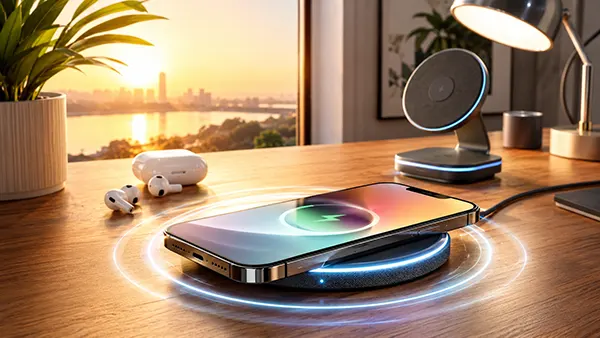
Should You Replace an Older MagSafe or Qi Charger?
An upgrade is not automatically necessary simply because Qi2 25W is available. An existing Qi2 15W charger remains useful with iPhone 17 and iPhone Air. It will not provide the maximum wireless speed available to either phone, but 15W can be entirely adequate for overnight charging, long periods at a desk or users who regularly place the phone on a charger before the battery becomes very low. In these situations, moving from 15W to 20W or 25W may improve top-up times without fundamentally changing the routine. The strongest reason to upgrade is therefore not the existence of a newer specification but a genuine need to recover a useful amount of battery during shorter charging sessions.
Older MagSafe equipment should be assessed in the same way. Apple has increased the capabilities of its current MagSafe Charger, but earlier MagSafe charging setups may have been designed around the former 15W charging level and lower-power adapters. If that setup is reliable and the phone normally charges overnight, replacing it may provide limited practical value. Someone who frequently starts the day with a partially depleted phone, charges between meetings or needs a substantial battery top-up before leaving home is more likely to notice the difference provided by the newer hardware. Before replacing the charging surface, it is worth checking the adapter too, because retaining an insufficient power supply can prevent a faster charger from operating at its intended level.
Conventional Qi charging is the clearest case where an upgrade can noticeably improve convenience. Apple notes that many ordinary Qi chargers charge iPhones at rates up to 7.5W, which is well below the 20W capability of iPhone Air and the 25W capability of iPhone 17. A basic Qi pad can still be useful beside a bed or in a location where the phone remains stationary for hours, but it is not the right choice for someone specifically trying to shorten charging time. Moving from a traditional Qi charger to MagSafe or certified Qi2 also adds magnetic alignment, reducing the chance that the phone will be positioned poorly on the charging coil and spend several hours charging more slowly than expected.
The Most Practical Choice for Each Type of iPhone User
For iPhone 17, the most balanced new purchase in 2026 is a current Apple MagSafe Charger or a certified Qi2 25W charger, combined with a power adapter that meets the charger’s requirements. Apple’s MagSafe option needs a 30W or more powerful USB-C adapter to provide its faster wireless charging mode. This setup allows the iPhone 17 to use its advertised maximum of up to 25W under suitable conditions. People who already own a reliable 15W MagSafe or Qi2 charger do not need to replace it for compatibility, but moving to 25W is worthwhile when short charging windows are common and the additional speed would regularly be useful.
For iPhone Air, a Qi2 25W charger is best treated as a charger with spare capability rather than a way to make the phone accept 25W. The Air itself is specified for wireless charging at up to 20W. Buying the newer charger can still be reasonable when prices are similar, when one accessory will also serve an iPhone 17, or when the user expects to keep the charger through several phone upgrades. Someone who already has a good 15W Qi2 or MagSafe setup and mainly charges overnight has less reason to replace it immediately. The difference between a technical maximum and a useful everyday improvement matters more here than the largest number printed on the accessory.
For a household with several phones, the safest general choice is a certified Qi2 25W charger or charging stand with clearly stated output for each charging position and enough power from its USB-C adapter. It can provide the full supported wireless rate to iPhone 17, while iPhone Air automatically stays within its own 20W limit. Users should still expect charging speed to vary with battery level, temperature, case design and phone activity. In practical terms, iPhone 17 owners who want the fastest modern wireless setup should target 25W, while iPhone Air owners should choose on design, certification and price with the understanding that their phone tops out at 20W. That distinction is the most important part of choosing the right wireless charger in 2026.
Related articles
-
 Mac mini with M6 in 2026: What Change...
The 2026 Mac mini is a more substantial update than …
-
MagSafe and Qi2 25W in 2026: Which Wi...
Wireless charging is more straightforward on the iPhone 17 generation …
-
 App Store 18+ Ratings and Declared Ag...
Apple’s age-safety rules are more detailed in 2026, but two …