
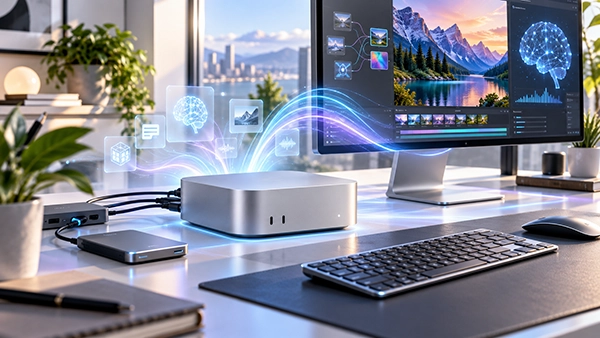
Mac mini with M6 in 2026: What Changed in Performance, Local AI and Peripheral Connectivity
The 2026 Mac mini is a more substantial update than its familiar exterior suggests. Apple announced the new model on 25 August 2026 with the M6 chip replacing M4 in the standard version, while the higher-end configuration moves to M5 Pro. Pre-orders are already open, with general availability beginning on 22 September 2026. The compact 12.7 cm square enclosure remains essentially unchanged, so the important differences are inside: a faster 12-core CPU, a new 12-core GPU, significantly stronger hardware for local AI, quicker memory, faster networking and several useful changes for people connecting displays, storage and other equipment. Apple is quoting sizeable performance improvements over the M4 Mac mini, although buyers should remember that, before retail availability, these figures come from Apple’s own July 2026 testing rather than independent long-term reviews.
M6 Performance: A Bigger Step Beyond the M4 Mac mini
The standard M6 Mac mini now uses a 12-core CPU, compared with the 10-core CPU in the previous M4 model. Apple divides those cores between two new high-performance “super” cores, four additional performance cores and six efficiency cores. The terminology is less important than the practical result: Apple states that CPU performance can be up to 40% faster than on the M4 Mac mini. This should be noticeable not only in demanding professional software but also during ordinary work involving large spreadsheets, photo libraries, code compilation, multiple browser windows and several applications running at the same time. Apple specifically reports up to 1.5 times faster calculations in Microsoft Excel than on an equivalent M4 system, although actual gains will depend heavily on the application and workload.
Graphics have received an even larger update. M6 contains a 12-core GPU rather than the 10-core GPU used in M4, and Apple says graphics performance can reach up to twice the level of the previous Mac mini. Hardware-accelerated ray tracing remains supported, but the new GPU architecture gives demanding games, 3D applications, image editors and video tools more processing headroom. In Apple’s testing, Cyberpunk 2077: Ultimate Edition achieved up to twice the ray-traced gaming performance of the M4 Mac mini. That does not turn the Mac mini into a dedicated high-end gaming computer, but it does make the standard model considerably more capable when software relies heavily on its graphics hardware.
Memory and storage performance also contribute to the improvement. The M6 Mac mini starts with 16GB of unified memory and can be configured with 24GB or 32GB. Depending on configuration, memory bandwidth reaches as high as 170GB/s, compared with 120GB/s on the M4. This matters because the CPU, GPU and AI hardware all draw from the same memory pool. Applications working with large images, video timelines and AI models therefore have quicker access to their working data. Storage capacities remain familiar, beginning at 256GB and extending to 2TB on the M6 model, but Apple says SSD performance can be up to twice as fast as before. Users handling very large project files should still consider 512GB or more, as the entry-level 256GB capacity can fill quickly.
What the Performance Changes Mean in Everyday Use
For routine office work, the difference between M4 and M6 will not always look dramatic on screen because the M4 was already fast enough for email, documents, web browsing and media playback. The value of M6 becomes clearer when several demanding tasks overlap. Exporting photographs while keeping dozens of browser tabs open, working in a large spreadsheet during a video call or editing high-resolution video alongside other applications should leave more performance in reserve. The extra CPU cores and increased memory bandwidth are therefore useful not simply because benchmark numbers are higher, but because the computer has more capacity before demanding workloads begin to compete for resources.
Creative workloads should benefit more visibly. The Mac mini still includes dedicated media hardware for H.264, HEVC, ProRes, ProRes RAW and AV1, so video processing does not depend entirely on the main CPU. Faster graphics add another advantage for effects, colour work, image processing and applications that increasingly use GPU acceleration. Someone moving from an older M1 or Intel-based Mac mini is likely to see a much larger improvement than an M4 owner. Apple reports, for example, that some M6 workloads are many times faster than on M1, while the difference from M4 is naturally smaller. That makes the age of the existing computer an important part of any upgrade decision.
There is also an important distinction between the M6 and M5 Pro versions of the 2026 Mac mini. M6 is aimed at the broadest group of users and provides the newest standard-generation chip, while M5 Pro is designed for heavier professional work and can be configured with an 18-core CPU, 20-core GPU and as much as 64GB of unified memory. The standard M6 therefore offers the more relevant improvement for general home, office and creative use, but sustained 3D rendering, large professional video projects and unusually memory-heavy workloads can still justify the Pro model. The new generation does not eliminate the difference between mainstream and professional configurations; it makes the standard Mac mini considerably more capable.
Local AI Is One of the Main Reasons for the Move to M6
The most significant architectural change in M6 concerns artificial intelligence. The 12-core GPU now includes Neural Accelerators, giving each GPU core hardware designed to speed up AI calculations. M6 also introduces what Apple calls a Dual 16-core Neural Engine. These components work alongside the CPU and unified memory rather than forcing every AI operation through a single part of the chip. Apple claims up to four times the AI performance of the M4 Mac mini in selected workloads and up to twice the Neural Engine performance of the previous generation. The improvement is particularly relevant to applications that can run machine-learning models directly on the Mac instead of sending every request to a remote server.
Local AI can cover far more than a built-in assistant. Apple specifically describes workloads such as running local language models, applying AI-based effects to photographs and creating automated agents that perform recurring tasks. Its own LM Studio testing showed prompt-processing performance up to 4.8 times faster than M4 under the tested configuration. Results from other models and applications will vary, but the direction of the update is clear: Apple has designed M6 so that AI workloads can use the GPU, Neural Engine and shared memory much more effectively. For users working with private documents or material that they prefer to keep on their own computer, stronger on-device processing can also reduce the need to transmit some data to external services.
The software side of this change is tied closely to macOS 27 and the next generation of Apple Intelligence. Apple has announced Siri AI with greater awareness of personal context, content shown on screen and information stored across supported applications. The company is also adding AI-assisted features to Safari, Photos, Shortcuts and system-wide writing tools. Timing matters, however. As of September 2026, parts of the new Apple Intelligence experience are still being tested, macOS 27 is scheduled as a free update for the autumn, and Siri AI is due to arrive in beta later in 2026 with English support first. The M6 hardware is therefore ready before every announced software feature has reached its final public form.
Memory Still Determines How Far Local AI Can Go
The M6’s improved AI hardware does not remove the importance of unified memory. Local models need memory to store their parameters and temporary working data, and that memory is shared with macOS and every other open application. The standard 16GB configuration is suitable for everyday Apple Intelligence features and many smaller local AI tools, but users intending to run more demanding models regularly should look closely at the 24GB and 32GB options. More memory does not automatically make every AI task faster, but it can determine whether a model fits comfortably in memory without placing additional pressure on the rest of the system.
This is also where the difference between M6 and M5 Pro becomes particularly relevant. M6 tops out at 32GB of unified memory, while the M5 Pro Mac mini can be configured with up to 64GB and offers substantially higher memory bandwidth. Apple itself points to the Pro model as the stronger choice for larger local AI models, large diffusion workloads and complex datasets. A buyer interested mainly in Apple Intelligence, productivity automation, photo tools and moderate local model use does not automatically need M5 Pro. Someone planning to keep large AI workloads running for extended periods, however, should consider memory capacity as carefully as raw processor speed.
For many users, the practical benefit of M6 AI performance will be that previously specialised tasks become easier to run locally on a small desktop. Transcribing material, organising content, processing images, summarising local documents and automating repetitive workflows can increasingly happen without treating AI as a separate service accessed only through a browser. Software support remains decisive, because applications must be written to take advantage of Apple’s Neural Accelerators and other hardware. M6 therefore should not be viewed as making every AI application four times faster. Apple’s “up to” figure comes from selected tests, while real performance depends on the model, software, memory configuration and the way the developer has optimised the application.
Peripheral Connectivity Gets Faster Where It Matters Most
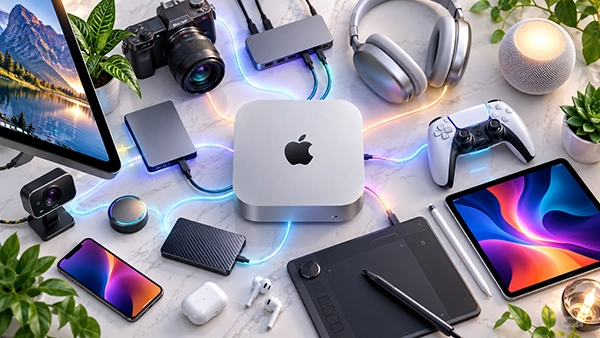
The physical port layout of the M6 Mac mini will look familiar to anyone who has used the 2024 model. The front still provides two USB-C ports supporting USB 3 speeds of up to 10Gb/s, together with a 3.5 mm headphone socket that supports high-impedance headphones. At the rear are HDMI, Ethernet and three Thunderbolt 4 USB-C connections with transfer speeds of up to 40Gb/s. This is worth highlighting because the standard M6 model has not moved to Thunderbolt 5. Thunderbolt 5 remains a feature of the M5 Pro version, where Apple specifies speeds up to 120Gb/s. Existing Thunderbolt 4 docks, external SSDs, audio interfaces and other USB-C equipment should therefore fit naturally into an M6 setup.
Networking receives the more meaningful upgrade. Standard Ethernet moves from Gigabit Ethernet on the M4 model to 2.5Gb Ethernet on M6, while 10Gb Ethernet remains an optional configuration. Apple has also replaced Wi-Fi 6E and Bluetooth 5.3 with Wi-Fi 7 and Bluetooth 6, using its N1 wireless networking chip. Wi-Fi 7 can provide higher speeds and better performance in busy wireless environments when paired with compatible network equipment, although buying an M6 Mac mini will not make an older Wi-Fi 5 or Wi-Fi 6 router faster. Bluetooth 6 is similarly designed for newer wireless accessories, while existing keyboards, mice, headphones and controllers using earlier Bluetooth standards remain compatible.
Display support remains generous for a computer of this size. The M6 Mac mini can drive up to three external displays. A three-screen arrangement can include two displays at up to 6K and 60Hz, or 4K and 165Hz, together with another display at up to 5K and 60Hz over Thunderbolt or 4K and 60Hz over HDMI. A two-display configuration can include one screen at up to 8K and 60Hz, 5K and 120Hz or 4K and 240Hz. These options make the machine suitable for conventional office displays, high-resolution creative monitors and high-refresh-rate screens without requiring an external graphics card. The exact supported combination still depends on resolution, refresh rate and the connection being used.
What Stayed the Same and What Matters When Choosing Accessories
The decision to keep Thunderbolt 4 on M6 means users should not expect a major increase in the speed of a single high-performance external drive or Thunderbolt dock compared with the M4 model. Both generations support up to 40Gb/s through their rear Thunderbolt connections. For most keyboards, audio hardware, card readers, ordinary external SSDs and display adapters, that is more than adequate. People working with exceptionally fast storage arrays or complex professional docking arrangements may find the M5 Pro model more suitable because its Thunderbolt 5 ports offer substantially more bandwidth. The distinction is important because the newer M6 name does not mean every connection is faster than the older M4 Pro configuration.
The move to 2.5Gb Ethernet as standard is likely to be more useful in homes and offices that already have faster network storage or multi-gigabit internet. A user copying large video libraries to a network-attached storage device, for example, can benefit without paying for the optional 10Gb Ethernet upgrade, provided the router, switch and storage device also support 2.5Gb connections. Wi-Fi 7 provides another route to faster networking without cables, but wired Ethernet remains useful for large transfers and work that benefits from consistent latency. The upgrade therefore improves both simple desk setups and more elaborate arrangements without forcing owners to replace existing accessories.
Overall, the 2026 M6 Mac mini changes most in processing power, local AI capability and networking rather than in its external design. Existing M4 accessories should remain straightforward to reuse, while Wi-Fi 7, Bluetooth 6 and standard 2.5Gb Ethernet prepare the machine for newer routers and peripherals. The most important purchasing choices are likely to be memory and storage rather than adapters: 16GB and 256GB keep the entry configuration compact, but 24GB or 32GB of memory and a larger SSD provide more breathing room for local AI, creative software and longer-term use. For M4 owners, the case for upgrading depends on workloads; for users coming from M1, older Intel Macs or less capable desktops, the combined CPU, GPU, AI and connectivity changes are considerably more substantial.
Related articles
-
Mac mini with M6 in 2026: What Change...
The 2026 Mac mini is a more substantial update than …
-
 MagSafe and Qi2 25W in 2026: Which Wi...
Wireless charging is more straightforward on the iPhone 17 generation …
-
 App Store 18+ Ratings and Declared Ag...
Apple’s age-safety rules are more detailed in 2026, but two …